
News Versus Arrest Logs
News archives and arrest logs answer different questions. A log is an agency record of bookings. A news outlet picks which cases to cover and may update one story as charges or hearings develop. That selection adds color. It cannot count every arrest in the window.
Search Eagle Country by date for Ohio County or Rising Sun, then weigh each claim against the named agency. Note the publication date separately from incident, arrest, booking, and court dates. If a photo runs with a story, trust its caption. Never assume it is a current booking photo.
Ohio County Multi-Day Arrest Log
The Ohio County Sheriff's Office posts no multi-day blotter. The county has no jail, so there is no local booking archive to page through. The sheriff may still hold the daily log record. The receiving facility keeps intake, transfer, and release records.
A multi-day inquiry should span the suspected incident date, the days around it, and the date a story or court filing appeared. It reaches wider than the 24 Hour Arrests check, which tracks same-day custody routing. Weekends cause gaps. Holidays do too. Short stays and delayed data entry can hide an arrest just as easily.
Read Ohio County Arrest Records
Start with the most authoritative record. Ask the arresting sheriff first. Then identify the receiving jail and compare the court docket, since news archives pick stories by interest rather than completeness.
- Set a date span that includes the incident and the following business days.
- Ask the sheriff for the daily bulletin or arrest-log entry and receiving destination.
- Search the receiving county in the Indiana Jail Public Search, which advertises a 30-day window.
- Check MyCase or the Ohio County Clerk for filed charges and later disposition.
- Review regional news only for context or later developments.
Track which office supplied each fact. A sheriff's report, jail intake, and court case may carry different dates and identifiers for the same event.
Arrest Log Entry Fields
The county has no public online log interface. So treat this list as a request checklist. An item below shows what to ask for or compare, not what any office guarantees to post online.
| Record detail | Likely source |
|---|---|
| Name and arrest date | Ohio County Sheriff |
| Arresting agency and incident number | Sheriff’s arrest or daily log |
| Booking and transfer time | Receiving jail |
| Charges as booked and bond | Receiving jail; confirm in court |
| Filed charge and disposition | MyCase or Ohio County Clerk |
| Booking photo | Only the agency that maintains it, subject to access law |
Booking happens right after arrest. Bond governs release while a case stays open. The court's resolution is separate, so keep those labels straight.
Local News Arrest Blotters
Eagle Country 99.3 Local News offers day browsing, a feed, an archive, and search. It covers southeast Indiana, including Rising Sun and Ohio County. Coverage is event-driven. Publication can trail an arrest by hours or days. It is not a booking list.
Regional stations like FOX19, WCPO, and WLWT also run selected Ohio County stories. A story image may be a scene photo, a file image, or an agency handout. Sometimes it is a booking photo. Only the caption can settle which.
The local-news archive interface shows day browsing and search.

The capture illustrates a selective news archive, not an official Ohio County arrest roster.
Weekend Arrest Record Gaps
A Friday-night arrest can land in the receiving jail's log before any agency report exists. A short stay may begin and end before anyone runs a custody search. Holidays close offices without stopping law-enforcement or jail work. So search booked and released date ranges. A single currently-held status is too narrow.
Court timing differs too. An initial hearing can come well after the arrest record. Someone who bonded out may still face an open case. The custody list shows nothing. Check the docket after the clerk files the case. Then ask the clerk for public offline records.
Ohio County Log Retention
Indiana's public-safety retention schedule draws a line between daily bulletins and other logs and case files. Daily bulletins can be destroyed after one year. Routine incident reports and logs may go five years after entry. Some felony, fingerprint, and inmate-custody series last longer. A few are permanent.
The schedule governs classification and retention, not online availability. A hold for litigation, an audit, or a pending records request can block normal destruction. When an old entry sits outside any web window, ask the sheriff which series applies and who still holds it.
Permanent or selected historic records may transfer under Indiana Archives and Records Administration rules. Ordinary records often reach authorized destruction instead. State-prison archives do not cover every Ohio County arrest.
Unofficial Ohio County Listings
Official records still come first. Among big third-party arrest sites, only Mugshots.com carries a genuine Ohio County, Indiana section. Other directories lack a verified county page. Some point to an Ohio County in Kentucky instead. Listings there run stale. Some entries get mislabeled or drift out of step with what a court later decided. Treat the unofficial Ohio County page as nothing more than a secondary glance at the landscape.
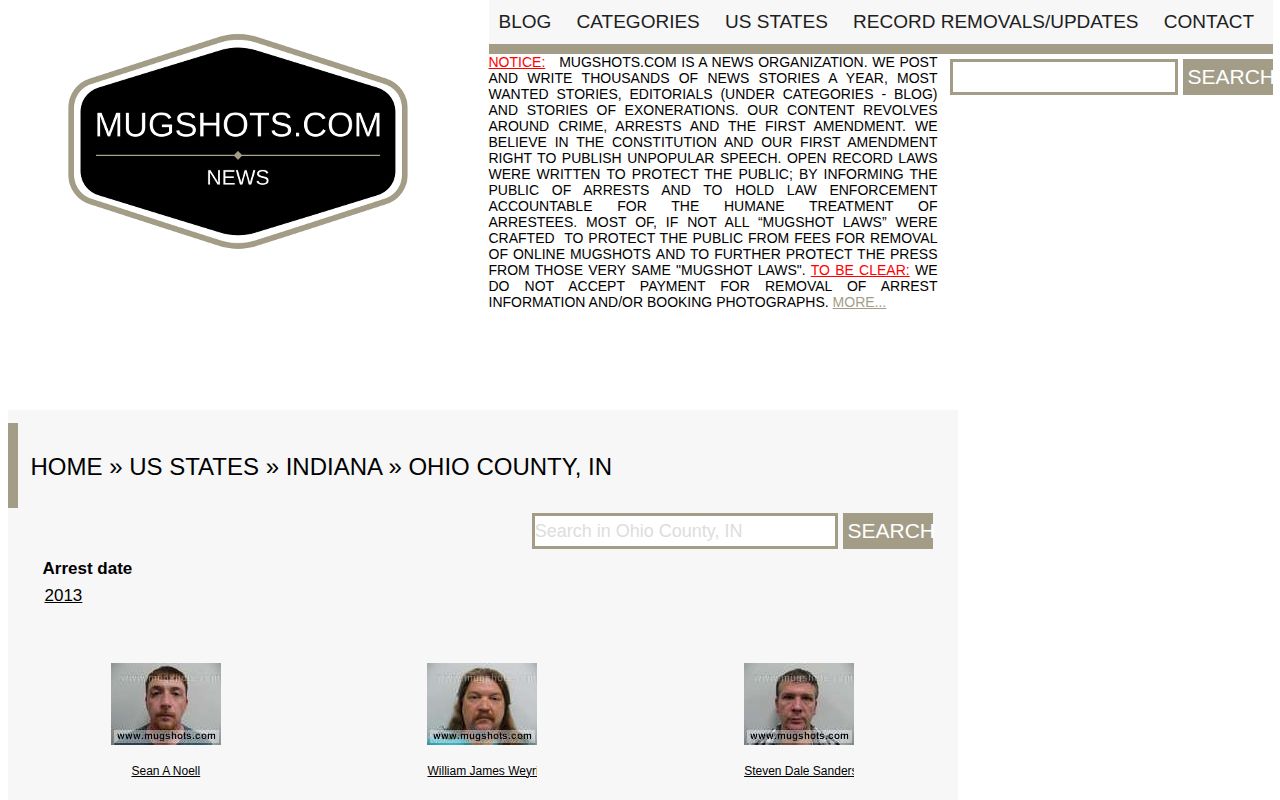
The listing is not an official feed. Treat it as neither a complete nor a current blotter of arrests. Never copy or rebuild a photo gallery from it. Instead, confirm any identity or case outcome with the sheriff, the receiving jail, and the court.
Request an Older Arrest Log
A narrow public-record request works best. Send it to the office most likely to hold the arrest record. Include the name, the date range, the record type, and any known incident or case number. The Ohio County Sheriff can supply its arrest or daily-log record plus transfer details. The receiving jail keeps booking, custody, transfer, and release records. The clerk holds the public court file.
If an office does not maintain what you asked for, request the name of the likely custodian. A written denial must state its legal basis. Inspection is not always the same as receiving a copy, and protected details may arrive redacted. Juvenile, sealed, and expunged records carry access limits. Never rebuild those from secondary sources.
For current custody after an older arrest, use VINELink Check. A jail release does not close the court case.
Search Public Records
Sponsored Results